Last time I mentioned that I placed temporary track down on the layout, simply to judge how all elements will fit together. The overall picture is coming into sharper focus and I'm happy with what I see!
That being said, allow me give you a tour of the New Castle Industrial Railroad :-)

We are standing near the right end of the layout at what is known as New Castle Junction (the eastern limit of NCIR ownership). The track running diagonal across the layout is the Conrail (now CSXT) main. The boxcars are on the CSXT/NCIR interchange track. The track in the foreground is the former Conrail New Castle Secondary main, now used by the NCIR as a storage track. There used to be a diamond crossing here, but it was removed when Conrail abandoned the New Castle Secondary east of the crossing. I plan to model the abandoned, overgrown ROW. The CSXT main will be well maintained code 148 rail on a nice bed of ballast. In contrast, the NCIR's track will be lighter weight. There will be a rusted signal standing guard at the former diamond, along with the foundation remains of a tower. Long ago, many trains must have passed through here every day!

Above is an aerial view of the junction. Note that the interchange track does not actually connect to the CSXT main. Rather, it climbs upgrade to join the main somewhere in the "off-stage" distance.

We are now looking due west down the New Castle Industrial. The CSXT main is in the foreground. Left to right we see (1) the old Conrail main, now used for car storage; (2) the NCIR/CSXT interchange track; and (3) Packaging Corporation of America's warehouse and dock track (where the cars are spotted in the upper right of the photo.

Looking east. Left to right: PCA's dock track (which will be on a higher grade); interchange track and old main. Cars are drilled into spot order using the interchange and old main. Overflow cars waiting to be spotted are stored on the old main.
 Picture an outdoor dock here, between the RBOX and the backdrop. Then picture a large warehouse where the cars in the background are spotted. The dock is where empty boxcars from the warehouse are reloaded with scrap cardboard. Tank cars of caustic soda are also unloaded here.
Loads on the old main waiting to be spotted. A conductor spends a lot of time here, shifting out cars requested by PCA on a given day's switch list. In the distance is NCIR's RS-11, tied down awaiting the next day's switching chores.
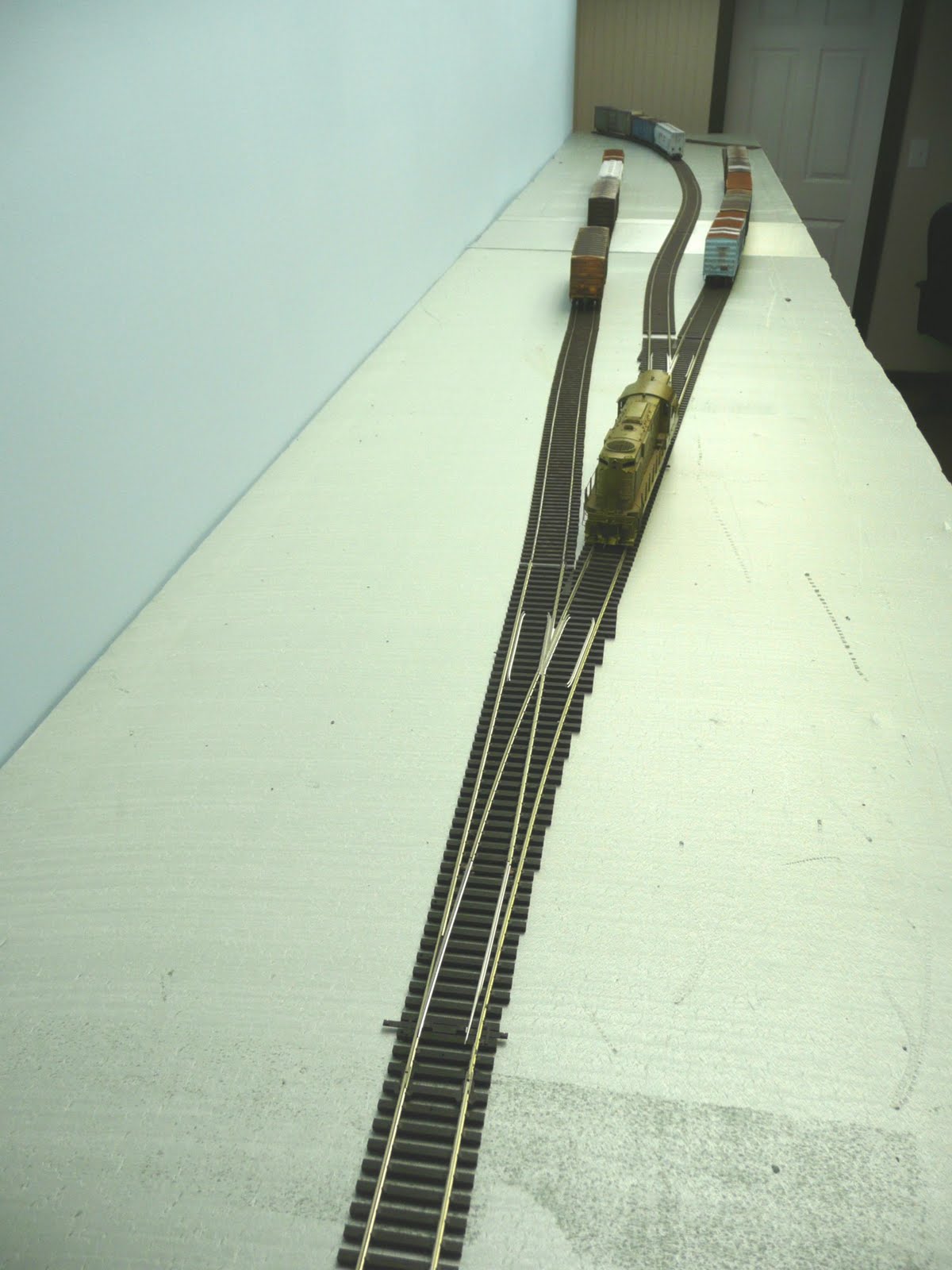
Above is an overall view of the layout. I'm excited! I think the O Scale New Castle Industrial will offer good operation and a variety of neat scenic elements in 18 lineal feet.

We'll conclude by looking at the left end of the train room. A long switching lead (staging track) will wrap around the far wall and over my cabinets. The track will be on a narrow wooden shelf. If I ever expand, I'll widen a portion of this shelf and add a chemical plant in the left corner, served by another trailing point switch. However, I'm getting way ahead of myself here:-)
And just for fun...

And just for fun...

I recently found this photo from August 2007, when we first looked at the house with our Realtor. This was the previous owner's workshop and storage room, which is now my railroad room. These last two photos were taken from roughly the same spot. Boy, the previous owners had a lot of stuff!
Thanks for taking the tour!!
Jack
Jack


